
Interventions
as part of the artistic practice
Within my practice, interventions are situational actions that operate within existing social, spatial or political structures. They do not function as autonomous works in the traditional sense, but as strategic gestures that shift, expose or re‑position a given context. Within my practice, interventions appear as temporary acts, spatial disruptions or performative insertions that activate the conditions of a place.

Nomansland - Development in the former border strip between East and West Berlin
Working in the former ‘nomansland’ between East and West during an Erasmus Student Exchange with the Hochschule der Künste in Berlin, my practice shifted from studio‑based image‑making toward direct engagement with space and context. Without access to a studio, the anarchist community of the Lohmühler Wagenburg became my working ground. Here, traditional painting transformed as spilled paint left coloured traces on the stones. By shifting and replacing these stones, I shaped outlines that echoed the surrounding houses, allowing the environment to become both material and collaborator.
These spatial traces opened conversations with residents about life before and after the Wall, revealing how form, memory and lived reality intersect. This period marks the moment where painting expanded into situational action, a transition from working on a surface to working with the social and spatial conditions of a place.

Arcadia - Development toward video‑based intervention in public space
Immediately after graduating, it became clear that working situationally within public and shared contexts would become an important direction in my practice alongside installation work. The communicative force of art emerges most clearly in the public domain, where interruptions of daily routines can render existing social structures visible.This shift moved my practice beyond objects and the flat surface and into spatial and situational forms. This development also brought new media into my practice. With Arcadia, video became a means of intervening in public space, confronting the idealised image of a location and exposing the tension between appearance and lived reality.

Connect - Spatial intervention through everyday materials
Intervention, Xiamen, China (2014)
Connect originated during an artist residency at the Chinese European Art Center in Xiamen, where clotheslines first entered my practice as a material for intervention. The shift toward working directly in public space had already begun, but in Xiamen it took form through simple, everyday materials that could activate the structures embedded in the environment. Connect marks the moment where spatial intervention became a way to expose and momentarily reshape the dynamics present within public space.
Intervening is understood literally: to come between. The clotheslines are attached above the ground, spanning between trees and defining a temporary spatial field. The lines create a situation within space to relate to. One can approach the configuration, come closer, or remain at a distance, positioning oneself toward what the lines mark and what becomes perceptible through that marking. The gesture introduces a moment of orientation: a minimal shift that makes the surrounding conditions visible.

A related work in the same series extends this logic: attached to the tree, the lines laid out on the ground mirror the crown above, evoking the unseen presence of the root system as a metaphor for hidden actualities.
While these works resonate with the realities of contemporary China, they remain open to interpretation, operating through a subtle spatial shift that activates the site.
View '40 Titles' project →
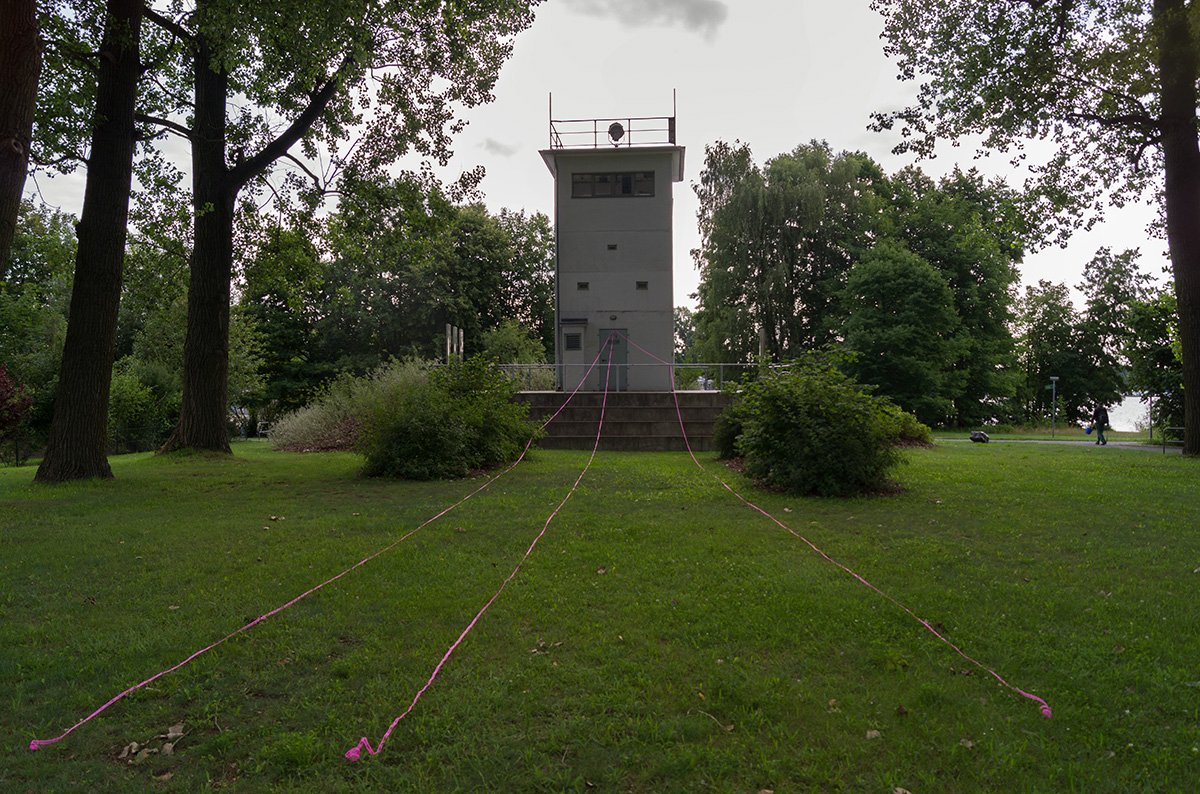
Grenzturm - Spatial intervention within border politics
'Grenzturm' (photo) 2016, Berlin.
At a former DDR border surveillance tower, I used clotheslines imported from China to extend the tower’s geometry into the surrounding landscape. Starting from its base, the lines formed an enlarging perspectival drawing across the grass, amplifying the structure beyond its physical limits.
The intervention engaged directly with the tower’s role within border politics: a structure built for surveillance, control and the enforcement of state boundaries. By projecting its outline outward, the spatial drawing temporarily reactivated this architecture of power while simultaneously destabilising it through expansion. The gesture shifted the tower from a fixed point of authority to part of an open, extended trajectory.
The resulting image was placed on Google Earth as part of the work, returning the tower to a global spatial system. ‘Grenzturm’ marks the convergence of political space, spatial drawing and situational intervention.
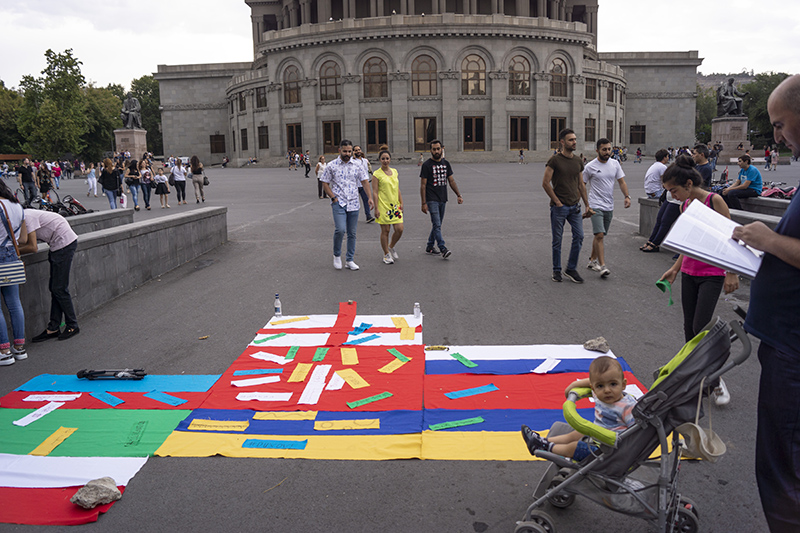
Flags - Collective intervention on Freedom Square, Yerevan
‘Flags’ is a floor‑based intervention realised on Freedom Square in Yerevan in 2018, the year of the peaceful revolution. The square is historically a politically charged site of public protest in Armenia, particularly against state oppression, oligarchic power, and pressures of external imperial control.
Coloured pieces of canvas were arranged into a composition reflecting the national flags of neighbouring states, placing questions of border politics and identity directly within a space shaped by civic mobilisation and collective memory.
Passers‑by were invited to write words related to identity and position them within the composition. Through this act, the floor piece became a temporary field where personal perspectives and geopolitical realities intersected.
The work was constructed from pieces of fabric rather than actual flags; this made it possible - as a politically sensitive gesture - to publicly tear apart the flag compositions at the end of the intervention.
The torn pieces were subsequently braided into a single multicoloured rope and used in other public interventions throughout historically significant or religious Armenian sites. In this way, the material moved through different contexts, retaining the marks of the collective act and creating conditions for new situations in which people engaged with it through interactions and spontaneous, site‑specific actions that emerged from the context and their presence at that moment.
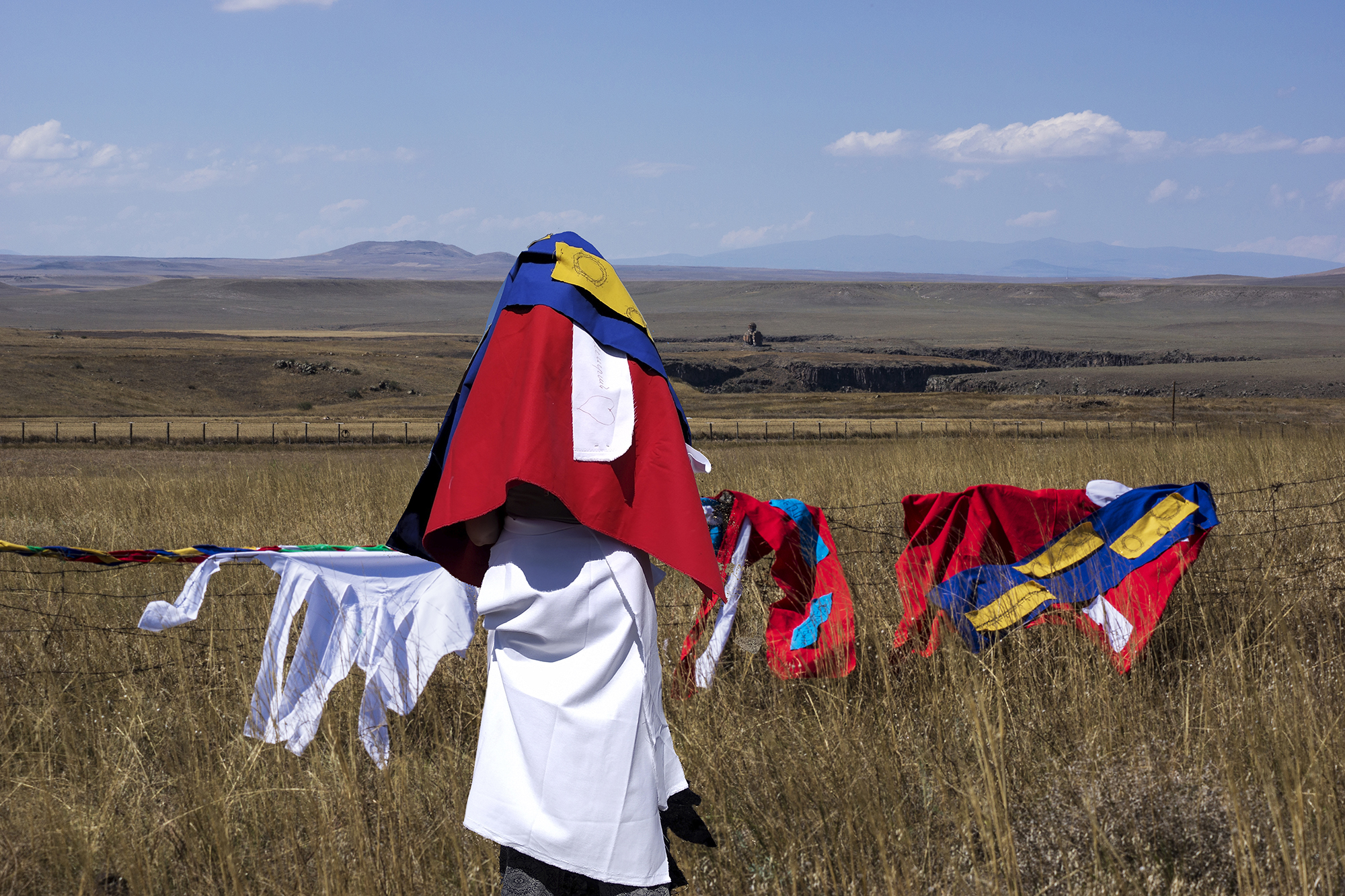
View on Ani - Intervention at the Armenian —Turkish border
'View on Ani' is a minimal intervention realised at the Armenian–Turkish border, a frontier defined by river gorges, trade boycotts and restricted access. From this position, the work overlooks the ancient city of Ani, a site of profound historical and cultural significance for Armenians, yet inaccessible due to the closed border.
Fragments from the ‘Flags’ composition were carried on the body from Freedom Square to the border site, the braided multicoloured string trailing behind, bringing the material and its prior action to the frontier that defines the very condition it addresses.
The gesture was positioned as close to the border as permitted, marking this limit through a precise situational act. Bringing the material to the frontier that defines the very condition those messages address, the condition of distance and the impossibility of connecting with ancestral history and origins shaped by power structures and border politics, engages the border as a condition rather than a location, activating its political and emotional weight.
View project Armenia →

Intervening Exhibitions - Maria Was Here
Exhibitions offer a distinct opportunity for intervention. Such interventions may be embedded within works produced in response to a curatorial framework. A clear example is the sculptural video installation Maria Was Here, developed for a call centred on medieval painter Lucas Gassel.
Exhibitions offer a context in which interventions can be developed within a specific curatorial framework. The sculptural video installation ‘Maria Was Here’ was created in response to a call centred on medieval painter Lucas Gassel. The installation takes Gassel’s depiction of Maria and Joseph as its point of departure and exposes the patriarchal fiction underlying this narrative by addressing Maria as a child bride. It brings this historical construction into the present, making visible how similar mechanisms persist today. The project also included the action ‘Stop Child Marriages’, realised as a fundraiser for Plan International.
View work →

Spot- A series of post‑material situational interventions
Interventions also emerge through self‑initiated projects outside institutional or commissioned frameworks. The ‘Spot’ series is a clear example.
The pieces in the ‘Spot' series are four photographs of ordinary kitchen stains of red cabbage on a gas stove. First presented in a solo exhibition at Eesdron art space in Germany, the images were read as constructed, post‑/modern artworks resembling watercolour paintings within a gallery context. Within this setting, they questioned the art space itself by introducing a domestic trace into a presentation framework shaped by traditional artistic categories.
After the exhibition, the same images were taken into public space and positioned in relation to landmarks and industrial structures. In these environments, their domestic character became explicit, shifting the reading from an art‑historical frame to a direct engagement with the situation in which they were placed.

The series later intervened in the interior of the Museum Helmond. Installed in the former council chamber of the museum, the images were aligned with antique shields representing historical territorial divisions and systems of governance. A subtle sound component of creaking opening and closing doors heightened spatial awareness and made visitors more attentive to the room and its historical elements. Within this intervention, the kitchen stains confronted the shields as emblems of territorial and institutional power, shifting the focus from heraldic authority to the space itself. In doing so, the work questioned the room, the institution and the political frameworks embedded in this council chamber.
The interventions with the ‘Spot’ series operate as a post‑material feminist gesture: a domestic element entering spaces defined by institutional and historical power, shifting how value and visibility are produced through context.

de-con-struct - intervention operating within a commissioned context
Site‑specific video intervention, former Begemann factory site, Helmond (2011)
‘de‑con‑struct’ is a site‑specific video installation developed for the Heritage Biennial, addressing how urban redevelopment constructs, reframes, or suppresses collective memory. The work examines the tension between archival documentation and the active manipulation of historical narratives through architecture, naming, and municipal decision‑making. Using archival material from the former Begemann steel‑construction company, historical images and video testimonies were digitally deconstructed and reassembled into a multi‑layered projection across windows, façade and monitor.
The installation foregrounds the discrepancy between the site’s industrial history and the narratives formalised through redevelopment, making visible how naming and spatial reconfiguration shape what is remembered and what is obscured in public space.
View project →
Interventions form a parallel line within my practice: a strategic mode that emerges when a situation requires an active response rather than a sculptural or spatial construction.