
Spatial multi media installation composed of architectural structures, video and a constellation of objects.
Created following a work period at the Chinese European Art Center (CEAC) in Xiamen in 2014, and presented as part of the total installation ’40 Titles II’ at Cacaofabriek Expo, Helmond, in 2015.
The Columbarium positions the viewer within a layered spatial environment in which multiple relations can be sensed. The installation brings different materials and registers together without forming a single narrative, allowing built, lived and social structures to appear alongside one another in shifting constellations.
The Columbarium juxtaposes different spatial and social structures. The video shows massive residential blocks surrounding an older, densely layered part of the city: stacked houses, informal growth, and a newer urban fabric built from repetitive, monumental forms. Together they outline a system that both contains and supports the people living within it. Built, lived and social structures appear alongside one another in shifting constellations. Each element carries its own logic, yet operates within the same set of constraints. The various elements do not form a single narrative; they create a field in which multiple positions become perceptible. The installation brings different structures into relation: architectural layers, domestic objects, gestures of direction and signals from elsewhere.
It makes visible how systems overlap, how boundaries operate, and how freedom takes form within the conditions that shape daily life.
Regulated and informal spaces appear side by side. Movement and limitation exist in the same frame. The installation places these conditions next to one another without resolving them.
The video shows large housing complexes surrounding an older part of the city, where informal stacked dwellings emerge within a system defined by regulation and control. These structures exist in the gaps of that system, spaces where people claim the freedom that is possible within imposed restrictions.
High above this landscape, a pigeon keeper works within a micro‑space. He calls his birds back with a red flag: a gesture of direction, control and limited freedom. His movements echo the conditions of the birds themselves: free, but within boundaries.
Two red flags appear in the installation. They refer to this gesture, to state symbolism, to signalling, and to opposing forces operating within the same system.
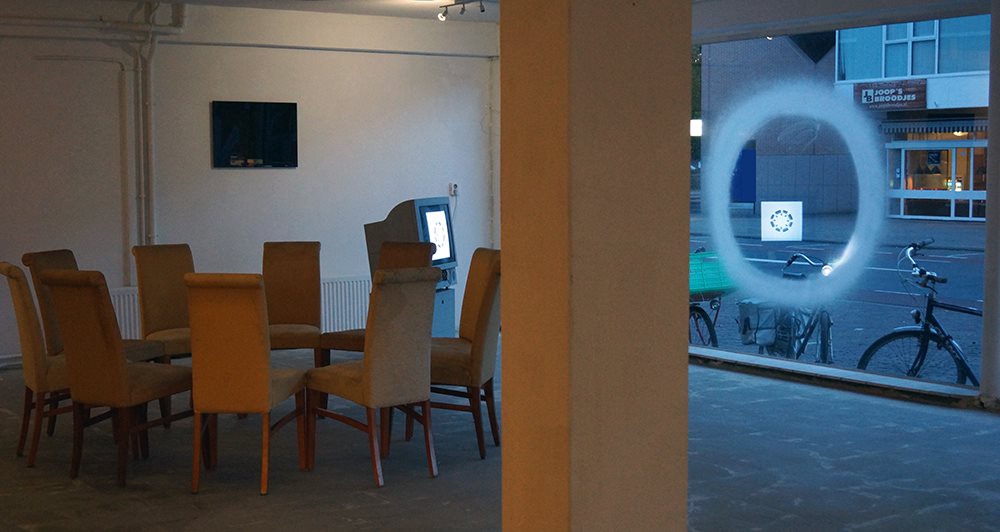
A satellite dish intercepts fragments of the video. Positioned between viewer and projection, it acts as an object that receives, filters and redirects: a device associated with communication, surveillance and control. These parts of the body of the installation stand out in black abstract lines against the projected video.
The tables stacked on tables recall houses built on houses, and relate to generational systems that shape how structures are carried from one generation to the next.
These tables were taken from households in Helmond and introduce a direct link between ‘there’ and ‘here’, between ‘they’ and ‘we’.
The Columbarium opens a set of relations that can be sensed rather than concluded. It traces how structures align, separate or overlap, and how freedom takes form within these shifting conditions.
The installation brings social, political, economic and familial systems into a spatial situation. It explores how people move within structures, how freedom and restriction coexist, and how private and public spheres intersect through acts of looking, signalling and controlling.
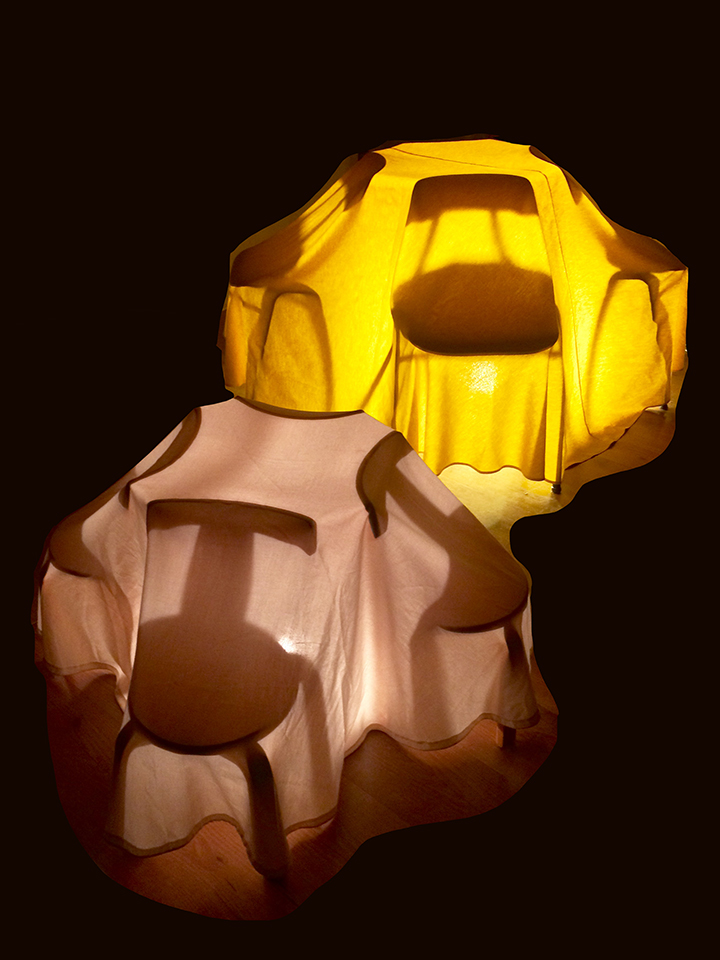
Photographic objects placed around and within the structure mark lived environments and function as tokens of how people anchor meaning, memory and presence within the systems that shape their daily lives.
Photo: the works gathered in the studio in Xiamen
Photographic work from public clothesline interventions, illuminated in the installation.
The clotheslines reappearing in the installation as recurring structural elements.
‘The Columbarium’ was presented as a total installation within the larger installation 40 Titles II.
view ’40 Titles’ project page →
View video documentation of the installation →