
Project Armenia
'Project Armenia' is part of a line of projects since 1996, addressing human aspects within the harsh realities of nation states, with a focus on identity, borders, power structures and geopolitical conditions in relation to (urban) landscape.
Point of departure for this project was a night photograph from my ongoing series in which I explore connections between contemporary situations and historical painting. The unfinished circular structure in the image recalled Pieter Bruegel the Elder’s Tower of Babel and opened a line of inquiry that extended beyond the photograph itself.
After completing '40 Titles', my second large‑scale project on identity, politics and the China–Europe relationship, I shifted my focus toward questions of ‘origin’. This led me to examine historical and geological migration routes and the emergence of nation states, tracing these trajectories back to the region where the tower was presumed to have stood.
This trajectory led me to Eridu in southern Mesopotamia (now Tell Abu Shahrain in Iraq), where the remains of a ziggurat closely echo Bruegel’s depiction. From there, my research expanded to the wider region around the Persian Gulf and the earliest known civilisation, Sumer.
Following this extended theoretical and historical line, the trajectory led to Armenia, where it connected directly to my China–Europe focus and to my earliest project from the 1990s, which addressed the fall of communism in Eastern Germany and the war in Yugoslavia. The Silk Road linked China to Europe through the ancient Armenian city of Ani — now situated in Turkey, on the present‑day border with Armenia.
During this research I recognised a direct relation to a key work I created in 2015, immediately after 40 Titles: 'Time Table With Memory Holes'. This work has become the central node connecting these projects. While grounded in a family history shaped by the political realities of twentieth‑century Germany — including the erasure and alteration of photographic records — the work primarily establishes the foundation for my ongoing focus on identity and my interest in human existence and our (in)ability to comprehend it.
From this point, I initiated the self‑directed project Project Armenia, and by the end of 2016, the Institute for Contemporary Art in Yerevan offered the appropriate context for further research and artistic development, leading to a residency planned for 2018. Shortly after this arrangement, the ‘Velvet Revolution’ unfolded unexpectedly in the spring of that year.

Impossibilities
In January 2017 — at a moment when there was no indication of the Velvet Revolution that would unfold in May 2018 — the project confronted a series of structural impossibilities. These emerged after an intensive period of research and became integral to the conceptual framework rather than obstacles to overcome.
The first impossibility concerned the idea of placing a large see‑through mirror at the border with Turkey. On the Armenian side, it would function as a shifting frame for the landscape, dependent on one’s position; on the Turkish side, it would appear only as reflection. Given the political situation at the time, realising such an intervention was unfeasible, yet the concept itself articulated the very conditions that defined the site.

Platforms
The accumulation of impossibilities made it necessary to work through a structure that could operate within those constraints. As a result, the project unfolded through a series of platforms — situational spaces that offered an alternative where other forms proved unworkable. These platforms were realised through interactive performances, site‑specific interventions, collaborations and presentations, each functioning as a temporary ‘free space’ articulated through distinct modules.
In developing Project Armenia, the conceptual starting point was a deliberate detachment from institutional space and conventional modes of presentation. The digital animation presents the cut colour planes within a fictive white‑cube setting and constitutes the conceptual introduction to the presentation at ICA Yerevan.

The digital conceptual drawing establishes the project’s point of entry and positions the artist wearing the cap from Malevich’s Portrait of Nikolay Punin (1933), marking the conceptual shift that structures the project.

Flags – Conceptual framework
The conceptual basis of the project was formed through the development of ‘Flags’. Its underlying principles of flexibility, connectivity and transformation shaped the entire trajectory of the work. Starting from an abstract digital composition of nation flags, the concept established a framework in which material, media and spatial configuration could shift in response to context.
In Armenia, publicly tearing, burning or otherwise desecrating national flags is strictly prohibited. To be torn apart in public space, as a statement regarding nation states, the quotation of art‑related abstraction was incorporated into the concept. That way, ‘Flags’ starts as a floor‑based constellation of coloured pieces of canvas, arranged into a composition reflecting the national flags of neighbouring states of Armenia. This approach enabled an interactive performance in which an abstract installation gradually transforms into a two‑dimensional representation of the geopolitical situation concerning Armenia.
A preliminary try‑out was carried out in the large hall of De Cacaofabriek in Helmond, where working from an elevated viewpoint made it possible to test the spatial logic of the project. During this try‑out, the large coloured canvases were created — material that later informed the development of subsequent stages of the work.

Identity, Abstraction & Symbolism
Taking into account that the colours of national flags often refer to elements of the landscape that become symbols of identity — and that flags themselves function as symbolic structures — a series of events was developed through interactive performances and site‑specific interventions across significant locations in Armenia’s public space, including Freedom Square, Gyumri, Metsamor and Lake Sevan, with the ‘Flags’ composition as a starting point.
The first stage took place in the garden of ICA. For this presentation, the coloured canvases were placed in a hanging position, arranged in such a way that the garden became “a three‑dimensional abstract painting,” as described by leading Armenian art critic Nazareth Karoyan (photo: left), founding director of the institute, in his announcement of the event.
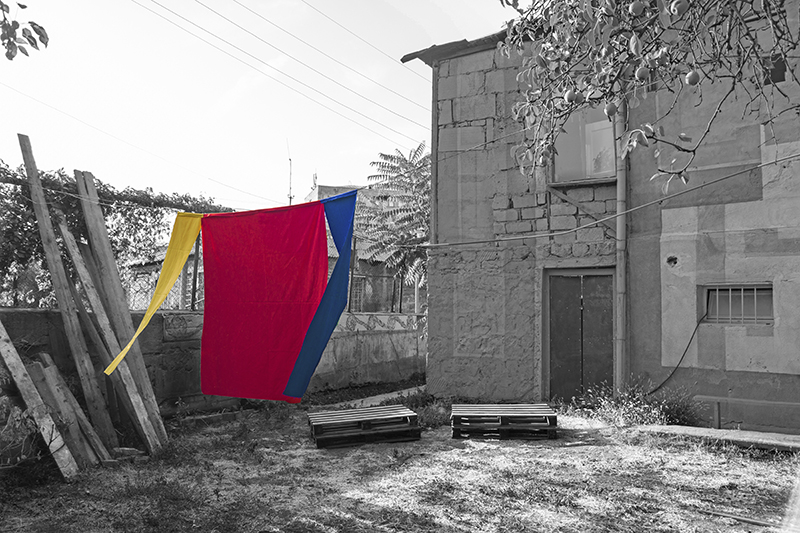
Within this setting, references to abstract (expressionist) painting formed another layer in the work; this constellation, for example, quotes Barnett Newman’s ‘Who’s Afraid of Red, Yellow and Blue’.

Participants were invited to create banners by writing words related to identity, politics and borders drawn from their personal lives position these within the composition. Through this act, the floor piece became a temporary field where personal perspectives and geopolitical realities intersected.
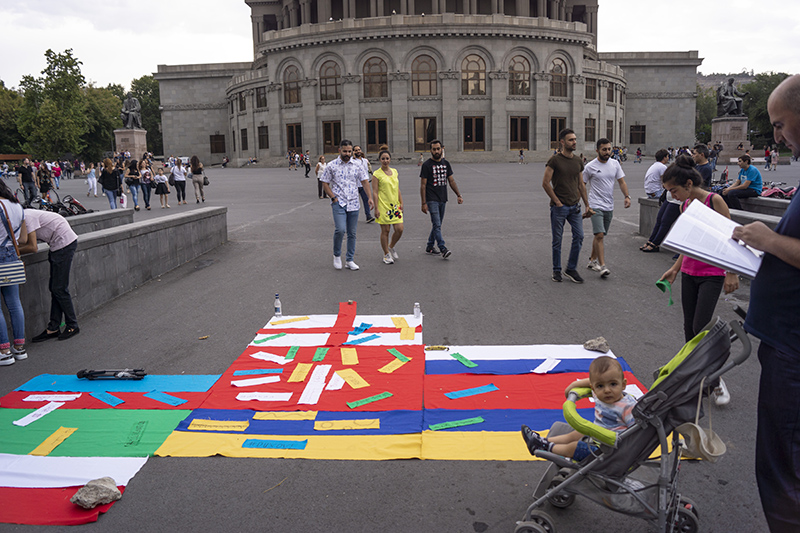
Flags - Collective intervention on Freedom Square, Yerevan
After the event at ICA, the intervention was realised on Freedom Square in Yerevan. The site had a significant role in successive waves of public mobilisation, from late‑Soviet demonstrations to protests of the 2018 peaceful revolution.
Passers‑by were invited to write words related to identity and position them within the composition. At the end, the pieces were torn into strips and subsequently braided into a single multicoloured rope to be used in other public interventions throughout historically significant or religious Armenian sites.
In this way, the material moved through different contexts, retaining the marks of the collective act and creating conditions for new situations in which people engaged with it through interactions and spontaneous, site‑specific actions that emerged from the context and their presence at that moment.

One Day - Total installation at ICA Yerevan
After the intervention on Freedom Square, a total installation titled ‘One Day’ was realised at ICA Yerevan, using the material that had been further processed. It was presented together with work that had emerged during my research period preceding the residency.
‘One day…’ can be read as a limited time frame, or as an expectation, a vision, a longing, a goal, set outside a certain time frame, always ahead of you.
All transformations become evident through the different stages that manifest in a temporary form.

The String
‘The String’ was created as a long braided element during the presentation, building on material that had already been used in the intervention on Freedom Square.

It became the basic component for the installation and for the site‑specific (interactive) interventions during the following seven‑day journey across Armenia.
Later it returned in a series of drawings. View drawings →
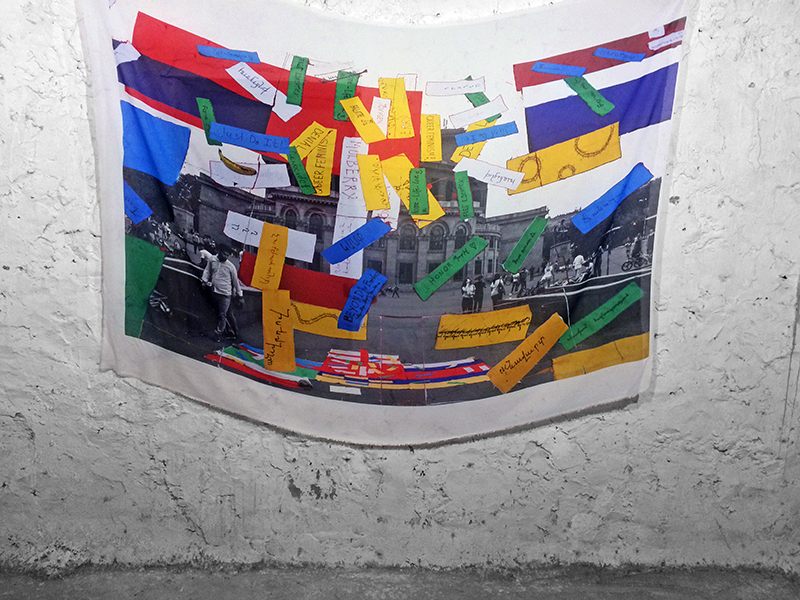
As a reference to the intervention on Freedom Square, I created a new flag incorporating the banners contributed by people and placed it over a photograph of the event.
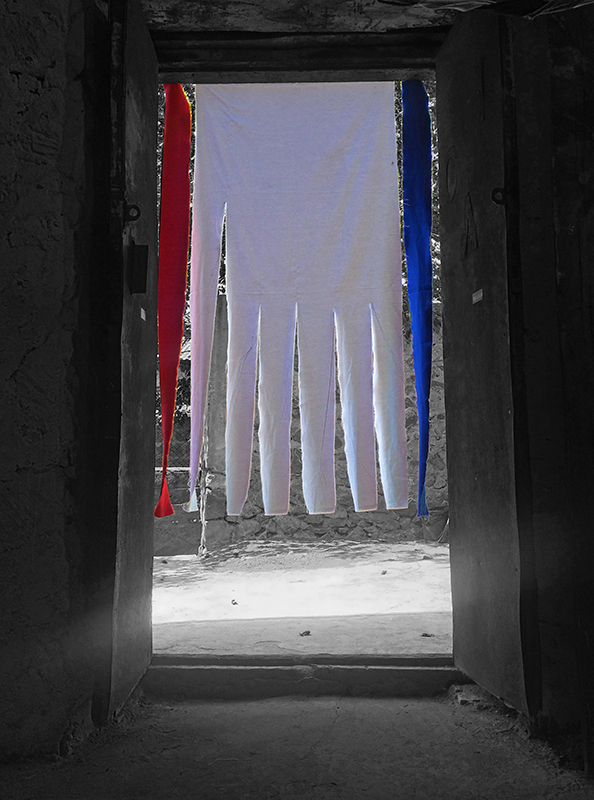
The Entrance - Sculptural intervention in ‘One Day’
This sculptural element presents a not yet fully torn composition derived from the Flag Composition, with partially separated strips at the bottom. The vertical arrangement of red, white and blue introduces a direct reference to the Russian flag. Positioned as both an entrance and an exit within the installation, the work marks a threshold that connects the internal space of One Day to the geopolitical conditions addressed in the wider project.
View Video →
The Journey - View on Ani
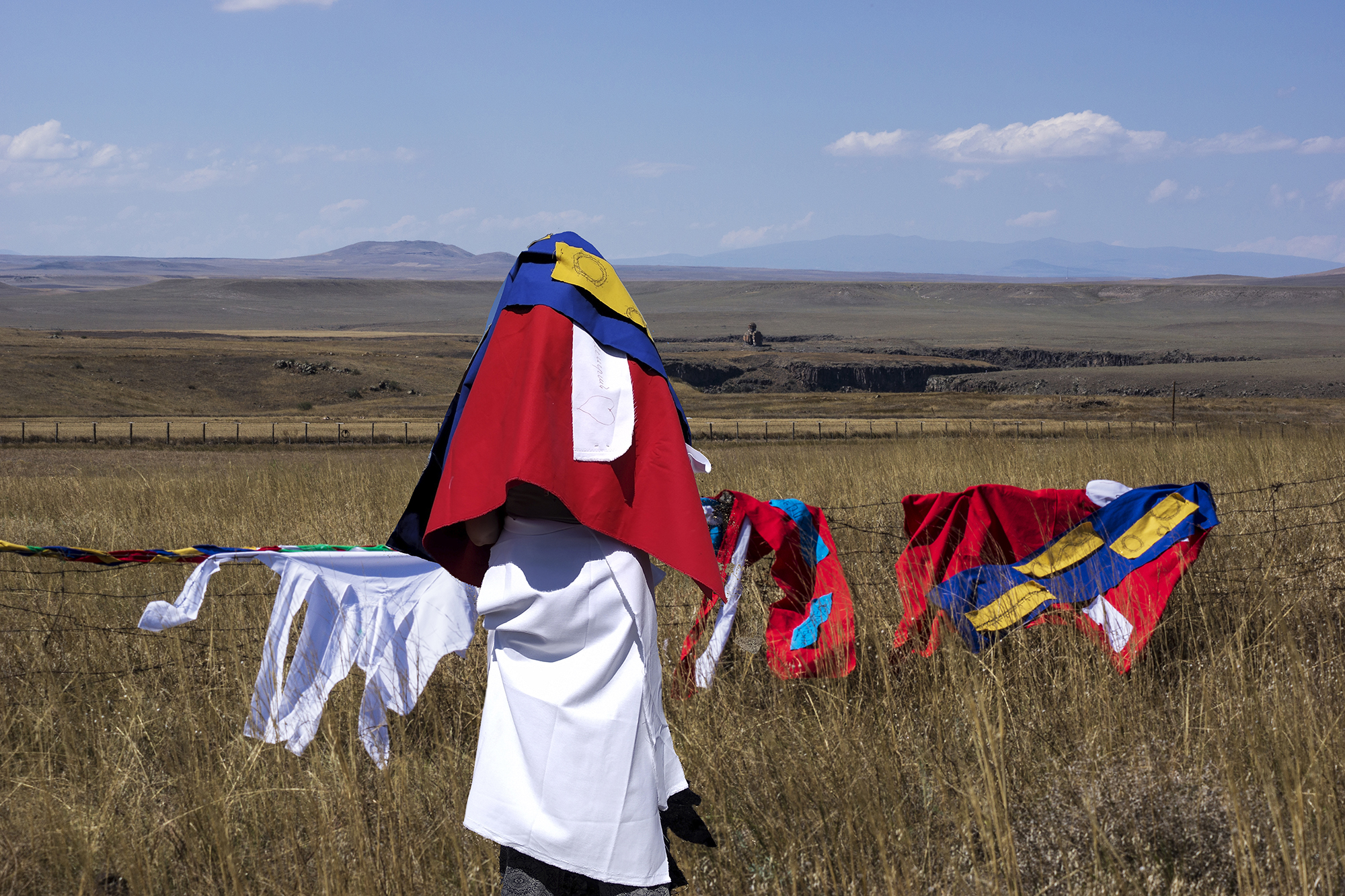
'View on Ani' is one of the interventions realised during a cross-country journey, taking place at the Armenian–Turkish border: a frontier defined by river gorges, trade boycotts and restricted access. From this position, the work overlooks the ancient city of Ani, a site of profound historical and cultural significance for Armenians, yet inaccessible due to the closed border.
Fragments from the ‘Flags’ composition were carried on the body from Freedom Square to the border site, the braided multicoloured string trailing behind, bringing the material and its prior action to the frontier that defines the very condition it addresses.
The gesture was positioned as close to the border as permitted, marking this limit through a precise situational act. Bringing the material to the frontier that defines the very condition those messages address, the condition of distance and the impossibility of connecting with ancestral history and origins shaped by power structures and border politics, engages the border as a condition rather than a location, activating its political and emotional weight.

The Conversation
Closing event of the journey was ‘The Conversation’ which took place in the famous ‘Writers House’ at Lake Sevan. Here ‘The String’ was integrated within the architecture of this 'brutalist' building, forming a circle that centered ‘The Conversation’ between the artist and one of the guests which happened to be an Armenian writer. Discussed were historical events, present politics and art in the context of identity and geopolitical aspects. This way controversial statements were brought to light. During this event it becomes clear that both participants have an oppositional view on migration and the conversation turns into a discussion: where the writer sees rejection and exclusion as a necessary security model for nation states, the artist seeks a more open border policy and focus on connection and inclusion.
The conversation was recorded as a time document.
The work aligns with the sculptural video installation ‘Time Table With Memory Holes’, 2016 View work →